
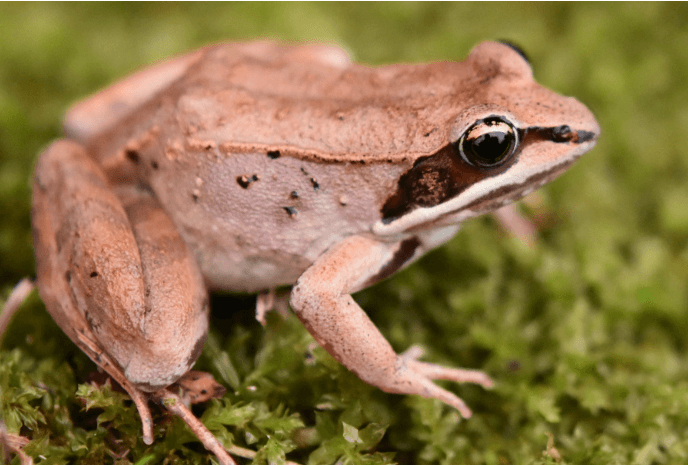
11. The Wood Frog
While almost all amphibians and reptiles perish if exposed to freezing conditions, the North American wood frog (Rana sylvatica) copes with harsh northern winters by allowing up to 65% of its entire body to freeze completely solid. When temperatures plummet, the frog enters a state of suspended animation: its heart stops beating entirely, its lungs cease breathing, its blood stops flowing, and its brain activity flatlines. As ice begins to form on its skin, the frog’s liver goes into overdrive, flooding its circulatory system with massive quantities of glucose and urea. These compounds act as a potent biological antifreeze (cryoprotectants), drastically lowering the freezing point inside the frog’s cells and preventing jagged, lethal ice crystals from forming and rupturing delicate cell membranes. The frog spends months as a solid block of ice, and when the spring thaw arrives, it warms from the inside out, its heart spontaneously restarts, and it hops away completely unharmed.
