
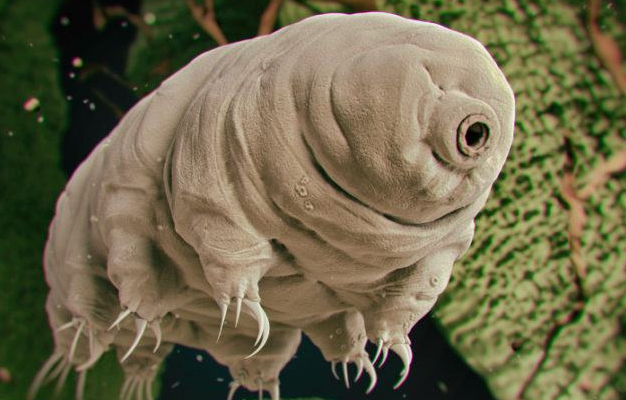
20. The Tardigrade
Measuring less than a millimeter in length, tardigrades (affectionately known as “water bears”) are microscopic, eight-legged invertebrates capable of surviving apocalyptic conditions that would instantly annihilate any other known form of life. When faced with lethal environmental extremes, they enter a state of suspended animation called cryptobiosis (specifically anhydrobiosis), expelling 99% of their water and turning into a shriveled, dehydrated ball called a tun. In this state, they synthesize tardigrade-specific intrinsically disordered proteins (TDPs) that literally turn their internal cellular cytoplasm into a glass-like solid, preserving their structures. They can endure freezing temperatures near absolute zero (-272°C) and extreme heat up to 150°C. They can easily withstand crushing pressures 6,000 times greater than the Earth’s atmosphere, and thanks to a unique DNA-shielding protein called Dsup (Damage Suppressor), they can survive massive doses of ionizing radiation and the absolute vacuum of open space.
