
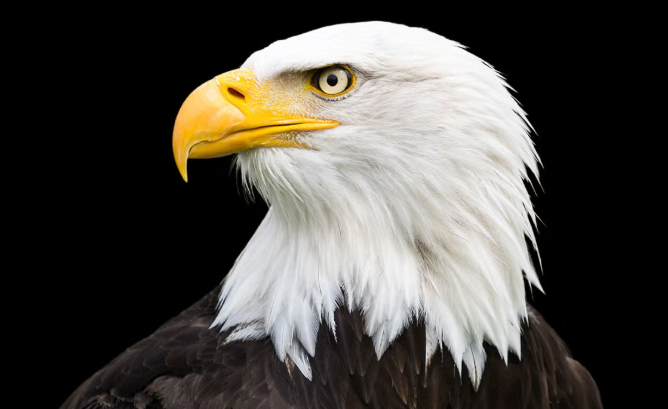
7. The Bald Eagle
An eagle’s vision is a masterpiece of biological engineering, optimized for extreme, high-altitude precision and tracking. While humans possess a single fovea (the part of the retina responsible for sharp, central vision), eagles have two distinct foveae per eye. This anatomical advantage acts like a built-in zoom lens, giving them the ability to simultaneously process peripheral movement and magnify the dead center of their field of view. Their retinas are densely packed with up to one million light-sensitive cone cells per square millimeter—roughly five times more than a human eye. Additionally, eagles can see deep into the ultraviolet (UV) spectrum, allowing them to track the glowing, UV-reflective urine trails of small rodents hidden in deep grass. This telescopic, multi-spectral visual acuity allows a soaring bald eagle to spot a camouflaged rabbit from over two miles away while cruising at an altitude of 10,000 feet.
